“Bro;ken”
Understanding the Effects of Post-Traumatic Stress
Introduction
Anyone who believes and is baptized will be saved.
But anyone who refuses to believe will be condemned.
Mark 16:16
Being the guardians and warriors of our society, firefighters, medics, cops, and emergency response dispatchers are all too familiar with the horrors they face daily. They experience and see things that most people cannot comprehend. First responders tend to overlook themselves in providing a much-needed service to the public. On any given day, they will be involved in horrible situations where death and loss are sudden and unexpected.
In 2019, there were 119 firefighters, and 239 police officers reported suicides.[1] In comparison, in the same year, 48 firefighters and 158 police officers died in the line the duty.[2] Mental illnesses that can result in suicide include depression and Post-Traumatic Stress injury (PTSi), which are brought on by repeated exposure to death and destruction.
Defined as “the act of intentionally killing oneself,” nearly all suicides result from terrible mental illness.
According to the World Health Organization, more than 800,000 people take their lives annually, accounting for one death by suicide every 40 seconds. In the United States, suicide is the 12th leading cause of death. In 2020, 45,979 Americans died by suicide. In 2015, suicide and self-injury cost Americans 69 billion dollars.[3]
Police officers, firefighters, emergency medical technicians (EMTs), and public safety communicators are essential in ensuring the public’s safety and health. Due to the conditions in which they work, their culture, and stress on both a personal and professional level, first responders may be at higher risk of suicide. This stress can be built up over time, known as “Chronic Stress,” or stress related to a specific incident, “Acute Stress.” Occupational stress in first responders is associated with an increased risk of mental health issues, including hopelessness, anxiety, depression, and post-traumatic stress, as well as suicidal behaviors such as suicidal ideation (thinking about or planning suicide) and attempts.[4]
Numerous studies have shown that firefighters and law enforcement officers are more likely to die by suicide than in the line of duty. 35% of police officers and 18–24% of 911 dispatchers are thought to have PTSi. Many first responders may turn to alcohol or other forms of self-medication. Sadly, many organizations don’t offer them a welcoming setting where they can receive assistance.
Among First Responders, the attempted suicide rate is more than ten times greater than the general population. The stigma associated with these everyday heroes does not allow them to seek help for the risk of harming their careers. First Responders typically self-medicate, with alcohol or drugs, and engage in risky behavior. Unlike their civilian counterparts, First Responders cannot call for help in a mental health emergency without risking their livelihood.
 According to the Substance Abuse and Mental Health Services Administration (SAMHSA), First Responders are the first to respond to incidents involving harm to others. Their work exposes them to grief, injury, pain, and loss. First Responders have demanding schedules and physically challenging job requirements, and they put their life on the line for others.
These daily experiences of death and destruction, coupled with the constant hypervigilance, cause emotional trauma leading to anxiety, depression, Post-Traumatic Stress injury, and suicidal ideation.
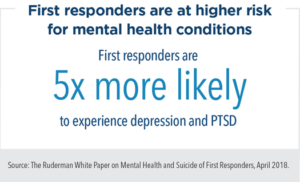
A 2018 white paper study by the Ruderman Family Foundation discovered that PTSi and depression rates among firefighters and police officers are up to five times greater than the general population.
The challenges that first responders face has grown significantly. Regulations and additional funds must be adjusted to address the group’s growing demands. Some strategies are beginning to take shape and show great promise for minimizing any adverse effects that first responders may be internally suppressing. We must address and support our first responders since it is no longer a hope but a necessity.
[1] Statistics from Blue H.E.L.P. – Honoring the Service of Police Officers Who Died by Suicide (bluehelp.org) and Firefighter Behavioral Health Alliance (ffbha.org)
[2] Statistics from Officer Down Memorial Page (ODMP) and Firefighter Fatalities in the United States (fema.gov)
[3] “Suicide Statistics,” American Foundation for Suicide Prevention, accessed 02/14/2020, Suicide statistics | AFSP
[4] SAMHSA. May 2018. Disaster Technical Assistance Center Supplemental Research Bulletin First Responders: Behavioral Health Concerns, Emergency Response, and Trauma.)